



Private Dog Walking or Group Walks: Which Is Better for Your Dog?
September 4, 2026
One on One or Group Dog Walks
Group walks suit social, high-energy dogs who thrive on company and need to burn off real energy. Private walks suit dogs who are nervous, reactive, elderly, recovering from injury, or simply prefer their own pace. Neither is better as a rule. The right answer depends entirely on your individual dog.
This guide covers what actually separates the two, which dogs do better in each, and how to tell if you have your dog in the wrong one.
What a Private Dog Walk Involves
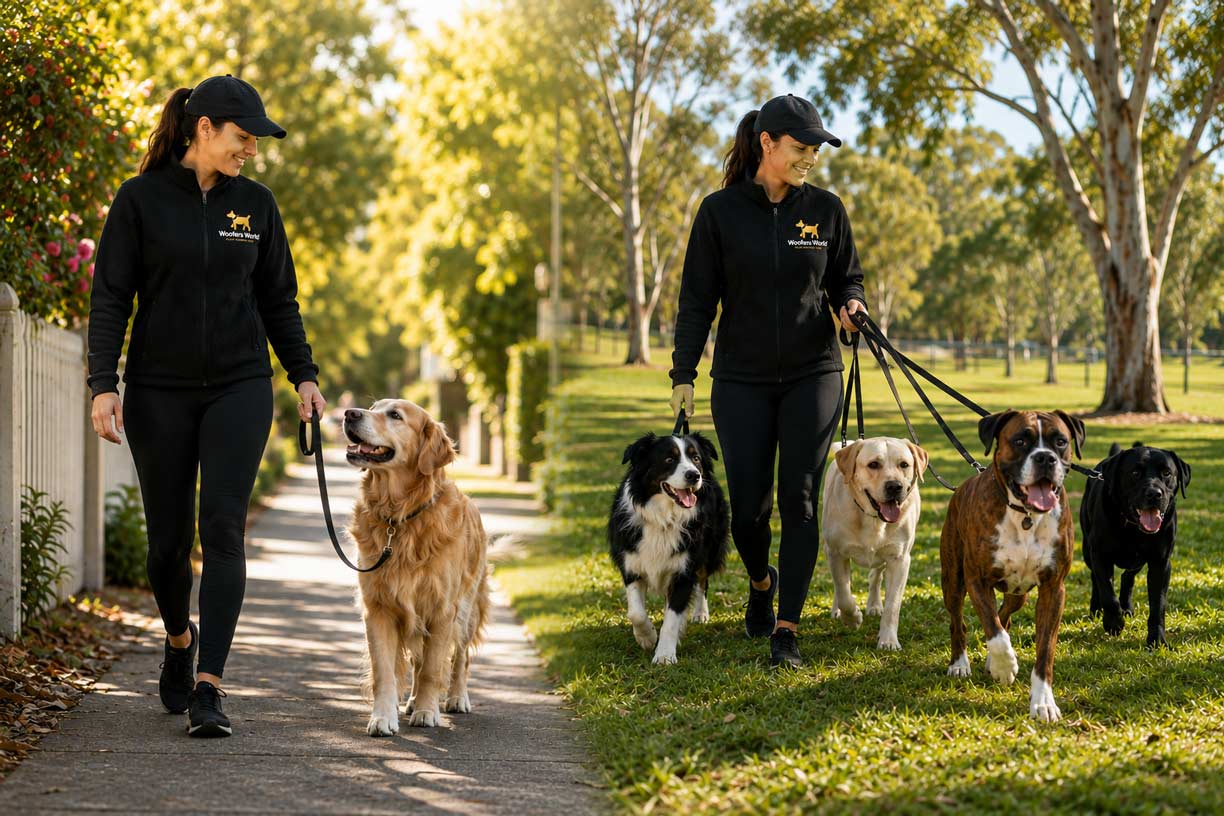
A private walk is your dog and the handler, nobody else. That means the whole session runs at your dog’s pace, on the route your dog likes, with the handler’s full attention.
Because there is no group to keep together, a private walk can be shaped around almost anything. A slow sniff-heavy amble for a senior dog. A hard run for a working breed with too much energy and no outlet. On-leash neighbourhood work for a dog still learning manners. Some owners use the session for a mix, part walk, part backyard play, part quiet company.
Private walks also suit dogs who cannot safely be around other dogs. A reactive dog does not need to be fixed before they can be exercised, they just need a handler working with them one to one.
What a Group Walk Involves
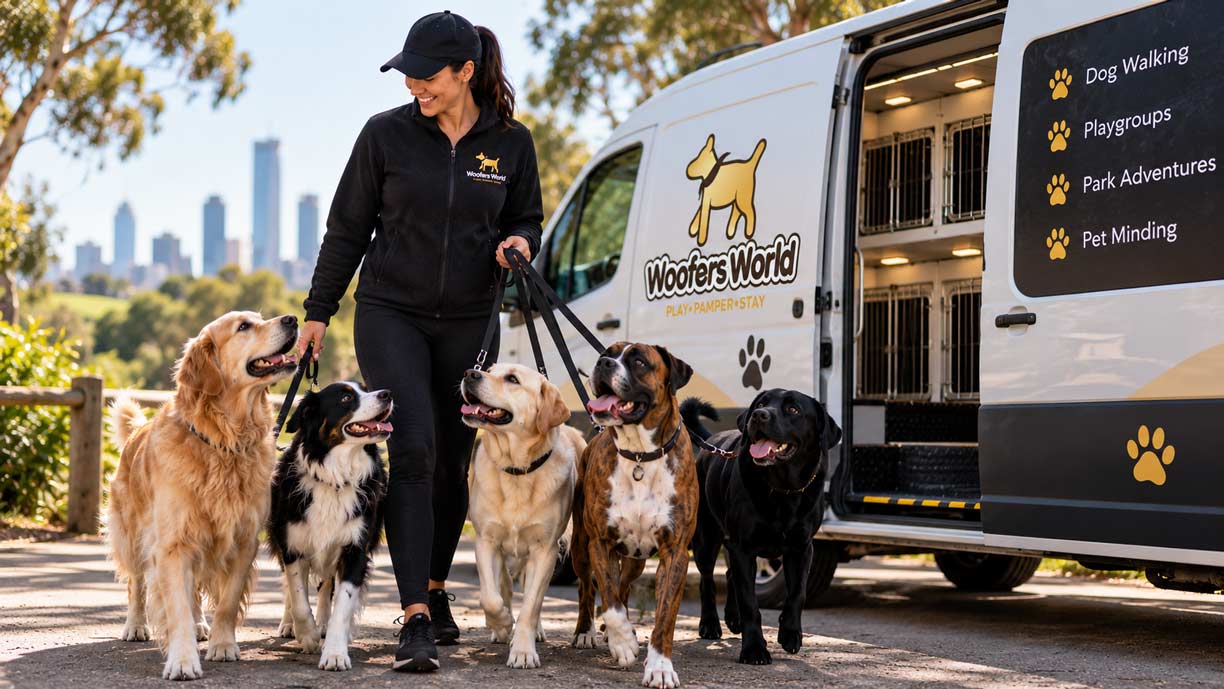
Group walks put your dog with a small number of compatible dogs and one handler. Woofers runs these as either playgroups, which are the shorter social sessions, or park parties, which run two and a half to three hours and cover more adventurous ground.
The value of a group walk is not the walking. It is the company. Dogs are social animals, and for a dog who genuinely enjoys other dogs, an hour with the pack does something a solo walk cannot. They come home properly tired, mentally as well as physically, because they have spent the session reading other dogs rather than just covering distance.
Groups are matched on temperament, energy and size rather than filled to capacity. A nervous small dog does not get put in with four boisterous adolescents, because that helps nobody.
Which Dogs Do Better in a Group
Group walks work well for dogs who:
- Actively seek out other dogs at the park rather than avoiding them
- Have energy left after a normal walk and get restless or destructive at home
- Are young, fit and looking for stimulation as much as exercise
- Have solid recall and reasonable manners on and off leash
- Live alone and get little dog contact during the week
The clearest sign a dog belongs in a group is what they do when they see another dog on the footpath. If the tail goes and the body loosens, they will get more out of a group than they will out of a solo lap of the block. Format is only half the decision. What to ask about handler training, group matching and transport is covered in our guide to how to choose a dog walker.
Which Dogs Do Better One to One
Private walking is the better call for dogs who:
- Are reactive, fearful or dog-selective, whether on leash or off
- Are elderly, arthritic or recovering from surgery and need a controlled pace
- Are very young or very small and would be overwhelmed by a group
- Have medical needs, medication timing or mobility limits
- Have never been socialised and would find a group frightening rather than fun
- Simply find other dogs stressful, which is common and not a fault
There is no hierarchy here. Plenty of perfectly happy dogs just do not enjoy other dogs, and forcing the issue with group sessions usually makes it worse.
Signs Your Dog Is in the Wrong One
Dogs are honest about this if you watch them.
A dog in a group who does not want to be there will hover near the handler, keep their body low and tight, avoid eye contact with the other dogs, or come home wired and unsettled rather than tired. Some start refusing the van.
A dog on private walks who should be in a group will pull hard toward every dog they pass, whine at the fence, get destructive at home despite daily exercise, or return from a walk with energy still to spare.
The other thing to watch is the recovery. A well-matched session leaves a dog settled within an hour of getting home. If yours is still pacing at dinner time, something about the format is not right.
Cost, Time and Practicality
Private walks cost more per session because the handler’s time is not shared. Group walks give you longer out of the house for less, which matters if your dog needs a lot of exercise on a working day. You can compare the current rates for private walks and group adventures before you decide.
Duration is the other practical difference. A private walk is usually shorter and more flexible on timing. A park party runs two and a half to three hours including pick-up and drop-off, so it takes a bigger bite out of the day, which is exactly what some dogs need.
Many owners end up mixing both. A group session midweek for the social side, a private walk on the days your dog needs something calmer or you need a specific time slot.
Getting the Match Right at Woofers World
Getting this decision right is easier when someone has watched your dog with other dogs before recommending anything.
Woofers has been walking Melbourne dogs since 2005, and every dog is assessed on temperament before being placed anywhere. Our private dog walking service covers one-to-one outings tailored to pace, age and ability, with pick-up and drop-off included. For social dogs with energy to spare, our group dog walking and park party adventures run small groups of four to six dogs matched by temperament, with a trained animal handler on every session and vans fitted with fresh water and a wash system for the muddy ones.
If you are not sure which fits your dog, say so when you book. The team would rather start your dog in the right format than move them after a session that did not suit.
The Bottom Line
Match the format to the dog, not to what sounds better on paper. Social, energetic dogs get more out of a group. Nervous, senior, reactive or recovering dogs get more out of a private walk. Watch how your dog behaves around other dogs and how they settle afterwards, and they will tell you which one they need. Get it right and the walk stops being a box you tick and becomes the best part of your dog’s day.
FAQs About Private and Group Dog Walking
Is private dog walking better than group walks?
Neither is better overall. Private walking suits nervous, reactive, senior or recovering dogs who need a controlled pace and full attention. Group walks suit social, high-energy dogs who benefit from company as much as exercise. The right choice depends on your individual dog’s temperament rather than on which service costs more.
How much exercise does my dog need each day?
Most adult dogs need somewhere between thirty minutes and two hours a day, depending on breed, age and fitness. Working breeds sit at the high end, flat-faced and senior dogs at the low end. Mental stimulation counts toward it, which is why a sniff-heavy group adventure often tires a dog more than a longer walk on familiar streets.
Can a reactive dog join a group dog walk?
Usually not, and that is not a reflection on the dog. A reactive or dog-selective dog placed in a group tends to get more reactive rather than less, because the situation is stressful rather than instructive. Private walks give them proper exercise without the trigger, and a behaviourist is the right next step if you want to work on the reactivity itself.
How many dogs are in a group dog walk?
Woofers runs small groups of four to six dogs, matched by temperament, energy level and location rather than filled to a number. Large commercial group walks with a dozen dogs and one handler are a different service entirely, and the supervision does not compare.
Are group dog walks safe?
They are when the group is matched properly and supervised by a trained handler who monitors interactions, watches the environment for hazards and practises recall throughout. What makes a group walk unsafe is poor matching and too many dogs per handler, not the format itself.
Do dog walkers pick up and drop off?
Woofers includes pick-up and drop-off on both private walks and group adventures, along with a water check and a security check of your home before we leave. You get a calling card showing what time we were there and where your dog went.
Related Articles
How To Choose A Dog Walker in Melbourne
Beyond the photos and the advertised walk time, a few questions tell you how a dog walking service really operates. Here is what to ask before you ...


Proudly Associated With